
Alternative Process Tutorials


Alternative Process Tutorial #4
Coating Paper
Intro Page: Part A
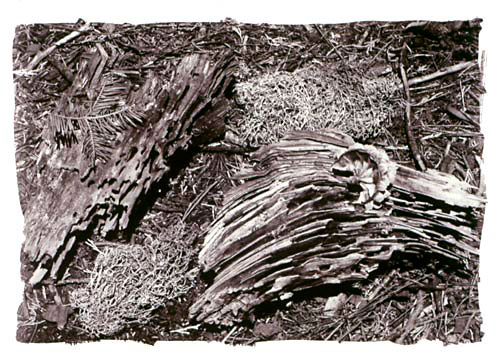
Illustration #24: Platinum Photo
Copyright © 1994 by Tom Ferguson
Click on image for larger view
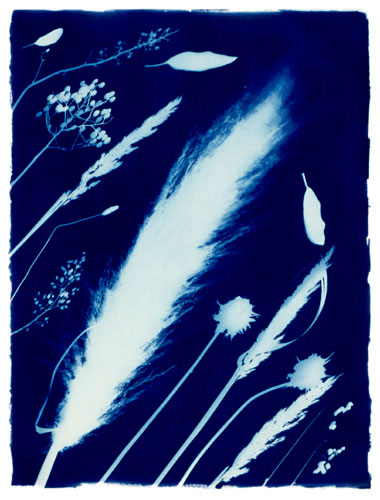
Illustration #25: Cyanotype photogram
Copyright © 1993 by Tom Ferguson
Click on image for larger view
Coating paper for alt processes creates far too much fear in most beginners. Perhaps it is the resemblance to oil painting, or perhaps it is just that too much has been made of the difficulties in the photographic press. It truly isn't hard, and can be learned quickly. By your fifth print coating session, you can be a "master".
There are two easy ways to coat paper for most alt processes. The traditional method uses a paint brush. The second method is to use a "coating rod" or "puddle pusher". Each method has advantages and disadvantages. Brushes are easy to purchase at local art supply stores, can be used to create rough edges and borders (see illustration #24), but use more chemistry, and often require some cleanup work to remove loose brush hairs and dirt (see illustration #33 / brush tutorial). Coating rods are easier for most most people to master, use less chemicals, but don't make traditional rough edges, require more set up before use, and do not work well on rough surface papers. Coating rods are a poor choice for gum bichromate prints. Both methods are described below.
Materials you will need for this tutorial:
- Chemicals mixed in tutorial #4 (Cyanotype A and Cyanotype B)
- Lab ware from tutorial #4
- Dark room to dry paper in
- Paper of your choice (see paragraphs below)
- Brush or coating rod (see links below)
- Masking tape (for brush coating)
- Plate glass (for rod coating only)
- Blank newpaper (for rod coating only)
One of the joys of cyanotype is that it can be coated on so many different papers, cloths, and surfaces. Unfortunately, each surface, indeed each type of paper, will require a different negative density range in order to print well. With the correct choice of paper, you can use conventional negatives developed to print on modern silver gelatin paper. This is why I've used cyanotype as the process to teach mixing chemicals, coating paper, and exposing.
Choose one or more large negatives that print well with a #2 or #1 contrast silver gelatin paper (or variable contrast filters). Remember that this, indeed most, alternative processes are contact printed. The size of your negative is the size of your print.
Papers I suggest for this lesson include:
- Platinotype white or natural (available from Bostick and Sullivan)
- Arches 90lbs watercolor
- Fabrino Aristico
- Somerset Satin
- Reves BFK (easily available, but not the best choice)
Most any paper will work, with varying qualities and contrasts. In general, a "neutral PH" paper is better than a "buffered" paper. Many drawing and watercolor papers are excellent. With brush coating you are free to experiment with textured papers, such as cold press or "rough" surface watercolor papers.
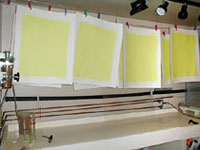
Illustration #26: Coated paper drying
NOTE: Dry paper in dark
Copyright © 2001 by Tom Ferguson
< Previous Page (Measuring) | Next Page (Options): Brush Coating or Rod Coating